
What a Clinton Resident Lookup Can Confirm
An official-record resident lookup is a chain of partial confirmations, not one master people file. The best first source depends on the clue already known. A parcel search is useful when an address or owner is known. A voter search needs a name, date of birth, street, city, and ZIP. XChange is for public case information. Vital records prove an event when access rules allow. Business and license records show affiliations, not a home.
| Record | What it confirms | Where to search | Access |
|---|---|---|---|
| Property roll | Current owner, parcel, situs, possible mailing destination | Davis Property Search | Public search; parcel data |
| Recorded deed | Named grantor, grantee, and dated transfer | Davis County REDI-Web | Paid image or office/mail copy route |
| Voter registration | Ordinary registration match, address, party, age range, status | Utah Voter Search | Public fields; protected records withheld |
| Court records | Public party, case type, filing, disposition, and documents | Utah Courts XChange | Search and document charges |
| Vital records | Birth, death, marriage, or divorce event and date/place | OVRS, Davis Health, Archives, FamilySearch | Eligibility and age restrictions |
| Business or license | Principal, agent, profession, license status, or discipline | Utah Commerce and DOPL | Public affiliation search |
| Cemetery or obituary | Burial, death, relatives, and former-address clues | Clinton Cemetery and library sources | Public fields; obituary is secondary |
Use the known clue as the first anchor, then seek a second source with a different custodian. A deed may be years old, a voter record may be inactive, a court address may be from filing time, and a business address may be a public office. These time differences are why a Clinton resident lookup should record dates rather than merge similar names. A second resident lookup should test the same name again only after the first result has been dated and labeled.
Search Clinton Court Records by Name
Clinton Justice Court is at City Hall, 2267 N 1500 W, with a published office phone of (801) 614-0760 and weekday hours of 8 to 5. Its page does not provide a local public name-search grid. The statewide route is Utah Courts XChange, supported by the court’s detailed help page. A match shows a public case relationship, not proof of current Clinton residence.
| Field or control | Type | What the search supports |
|---|---|---|
| Jurisdiction | Choice | District, Justice, or both |
| Search type | Choice | All court cases or judgments only |
| Case number | Text | Exact case lookup when known |
| Last name or company | Text | Party surname or company |
| First name | Text | Asterisk returns variants or a middle initial |
| Case type and scope | Choices | Case category and statewide, county, or court range |
| Birth date | Date or text | Optional disambiguator, often shown for criminal defendants |
| Citation number and location | Text or choice | Narrow a citation search when known |
| Date range panel | Toggle | Reveals filing-date filters |
Results can show county, court location, case number, filing date, case type, party names and codes, judge, attorneys, charge or claim summary, disposition, proceedings, judgments, orders, minutes, and public document links. Searches cost $0.20, a guest account is $10, and public documents are generally $1 each. XChange pages cap results at 500. No live Clinton docket was captured, so the field list is an inventory, not a named sample.
Image lead-in: The Utah Courts XChange help page documents the search controls and public result fields.
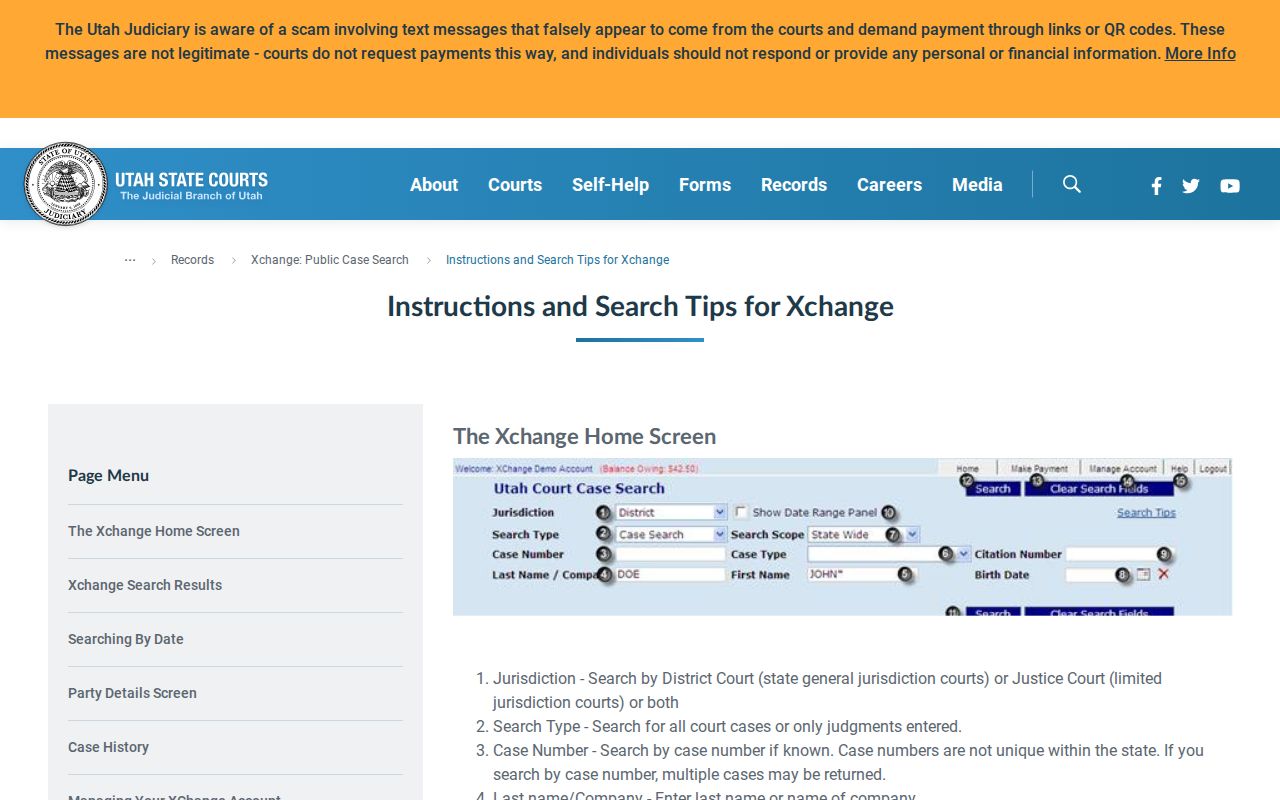
The image illustrates the statewide court search route. It does not reproduce a named Clinton case or establish that a person is a current resident.
Separate Similar Clinton Names
The same-name trap is serious in the growing Davis County corridor. One person may appear as a grantor, voter, business principal, or court party without being the Clinton resident under review. Search a full legal name, middle initial, shortened first name, maiden or married name, suffix, likely misspelling, and business name. In XChange, the documented asterisk behavior can help find first-name variants.
Require at least two independent anchors before combining records: a full name plus DOB or age range, the same parcel and legal description, the same street and ZIP, a spouse or parent relationship, a dated business filing, a court document address, or an obituary naming the same family and cemetery. A 84015 match can involve Clinton, Clearfield, Sunset, West Point, or another location in the county’s city-by-ZIP table. ZIP alone is not identity proof.
Note: The Davis County Recorder can provide public index or copy help during office hours, but staff do not conduct title searches or certify a person’s identity from a name alone.
Verifying a Clinton Resident’s Records
A sound Clinton resident lookup uses the name as a lead and the address, parcel, age, family link, or date as the test. Start with the property or voter record only when its purpose fits the question. Then compare the court or vital result with a separate custodian. A court party role does not establish current residence. A deed establishes a recorded transfer. A voter match describes registration for an ordinary public record. A death or marriage record confirms an event under its access rules.
- Anchor the name to a parcel, situs address, or ordinary voter address. Note whether the property mailing address differs from the Clinton situs.
- Run XChange with name variants, jurisdiction, case type, scope, and date range. Use the asterisk behavior for first-name variants when helpful.
- Compare the party role, court, case number, filing date, DOB or age when shown, and public case history. Do not merge a same-name hit by surname alone.
- Use a vital index, obituary, cemetery entry, or FamilySearch image to test relatives, event place, and dates. Historical images do not automatically confer certified-copy access.
- Request a certified copy only from the correct custodian and only when the statutory relationship or other eligibility is met.
- Docket
- The court’s running record of filings, hearings, orders, and other case events.
- Index versus image
- An index is a searchable entry or summary. An image is the underlying scan, which may have a separate fee or restriction.
- Certified copy
- A custodian-issued copy certified as a true copy when the requester meets the record’s access rules.
Find Clinton Heirs and Classmates
A Clinton resident lookup can serve a family-history question without treating every result as a current address. For an heir, begin with a recorded deed and grantee name, then check public probate or court records for an estate, fiduciary, heir, or beneficiary. Pair any probate name with an obituary and parcel legal description. A complete Davis County probate index was not located, so the official fallback is a precise clerk, catalog, or court request.
For a birth-parent question, Utah adoption records are generally sealed under Utah Code 81-13-103 and court rules. An adult adoptee’s official route is the Utah Adoption Registry and authorized state or court channels, not an open name search. A former classmate may be found through Davis County Library microfilm, yearbooks, Utah Historic Newspapers, an obituary, or an alumni notice. Exact Clinton yearbook runs were not published, so ask the library for its current inventory.
The Clinton Cemetery viewer is another historical endpoint. City code describes open interment fields including decedent name, place of death, burial date, and the funeral director or person making the interment. The viewer’s live controls and a sample Clinton record were not text-exposed. Burial is useful corroboration, but it is not proof of last residence.
Use Clinton Vital Records for Events
Vital records confirm events, not an open directory of current residents. Utah OVRS maintains statewide death records from 1905 to the present. Davis County Health Vital Records serves statewide Utah birth and death events from its Clearfield counter at 22 S State Street, with phone (801) 525-5150 and email vitalrecords@daviscountyutah.gov. Its page lists county-counter figures of $25 for birth, $35 for death, and $10 for additional copies. The state FY25 schedule lists different figures, so verify the custodian and channel before ordering.
Birth records are restricted for 100 years and death records for 50 years under Utah Code 26B-8-125 and agency rules. Before those periods close, a certified-copy applicant must show a direct, tangible, and legitimate interest, such as the subject, immediate family, guardian, legal representative, an approved purpose, or a court order. The state acceptable-ID route requires one current primary photo ID or two secondary IDs for many requests.
Historical searches follow a different path. Before 1898, use city or county registers, cemetery, church, obituary, physician, or funeral sources. County clerks handled 1898 through 1905, and statewide certificates began in 1905. FamilySearch’s 1869 to 1953 Davis collection and the Utah State Archives can expose images or indexes while certified-copy rules still apply.
Read Clinton Search Results in Context
A result becomes useful when its fields are kept with the search path. For a court result, preserve the jurisdiction, court or county, name spelling, case type, number, filing date, and any public document link. For a property result, preserve the parcel and legal description. For a voter match, preserve the full street, city, ZIP, and date checked without copying private fields.
| Party identity | First and last name, party code or type, and DOB when the public result provides it |
|---|---|
| Case identity | County, court location, case number, case type, filing date, judge, and attorneys |
| Case history | Public charges or claim summary, proceedings, plea or disposition, judgments, orders, and minutes |
| Document layer | Available public documents and links, subject to the court’s coverage and access rules |
| Property cross-check | Owner, situs, mailing address, parcel ID, legal description, values, and recorded-document links |
XChange excludes sealed and expunged matters, juvenile delinquency, child-welfare matters, sealed adoptions, civil commitments, and other nonpublic records. A no-result does not prove that no case ever existed. Public documents may be requested from the court, usually within 10 business days, using the court’s specificity, inspection, copy, and fee rules.
- Docket
- The court’s running record of filings, events, orders, and case activity.
- Index versus image
- An index is a search entry or summary. An image is the scanned document, and it may have a separate charge or access rule.
- Certified copy
- A copy issued by the custodian with a certification that it is a true record copy, when the requester qualifies.
Legal Limits on a Clinton Resident Lookup
GRAMA, Utah’s Government Records Access and Management Act, provides access and appeal routes, but it does not turn every government-held personal field into a public directory. A custodian may withhold private, protected, controlled, restricted, or nonpublic material and release a redacted remainder. A precise request names the record class, person or parcel, and date range. The city’s records page says a request is for an existing record, not a new dataset created to answer a question.
Utah Safe at Home gives qualifying survivors a substitute state-office address while protecting the actual home and mailing address, city or county, precinct, phone, and unique identifying data. Certification lasts four years and can be renewed. Voter withholding under Utah Code 20A-2-104 is separate. Public fields can include name, address, party, age range, district, active or inactive status, and some vote-history fields, while SSN, Utah ID, full DOB, signature, email, and phone remain private. A withheld voter record can still exist in other databases.
The Utah Consumer Privacy Act applies to covered businesses meeting statutory thresholds and provides access, deletion of consumer-provided data, portability, and some opt-out rights. It is not a general deletion command for county deeds, court indexes, voter rolls, or vital custodians. Driver records are also not a public address source because the federal Drivers Privacy Protection Act restricts personal information from motor-vehicle records.
Lawful use. A Clinton resident lookup is for specific, lawful personal research. Utah stalking law does not permit repeated unwanted contact, surveillance, threats, intimidation, or publication meant to expose a protected person.
When an online trail stops, use the correct fallback. Ask Clinton City for an existing permit or cemetery file, the county catalog for a series reference, the court for a specific public file, or Davis Health and OVRS for an eligible vital copy. Keep private identifiers out of any published note.