
Clinton City Directory Collections
The verified Clinton city directory landscape is a set of local shelves, state catalogs, and mixed county images, not a single complete run. Davis County Library is the local holdings lead. Its Farmington headquarters offers a public microfilm reader and a Davis County and Utah local-interest collection, while the Syracuse branch explicitly serves Clinton, Syracuse, West Point, and western Layton and Clearfield. The public library pages do not publish a full shelf inventory.
| Collection | Years | Where held | Access |
|---|---|---|---|
| Clinton city directories | Exact run not published | Davis County Library lead | Ask Farmington or Syracuse to confirm shelf years |
| Reverse or criss-cross directories | Exact run not confirmed | Library and catalog search | In-person holdings check |
| Utah, Davis County Records | 1869 to 1953 collection label | FamilySearch images | Search or browse 40,381 images; restrictions vary |
| Midwife records | 1895 to 1909 | FamilySearch catalog item 189235 | Historical evidence; image access may vary |
| Burial records | 1905 to 1920 listed range | FamilySearch catalog item 189235 | Cemetery and identity cross-check |
| Utah Historic Newspapers | Exact Clinton run not published | Davis County Library and University of Utah | Library card route; notices and obituaries |
| State Archives collections | Series dates vary | Utah State Archives and Digital Archives | Name, agency, series, and digital searches |
No official page inspected published exact Clinton directory years, publishers, last printed year, reverse-directory years, telephone-book years, obituary-index years, or an abbreviation key. Those are documented gaps. Do not turn a familiar commercial title or a guessed date into a local fact. Ask Farmington history at (801) 451-3030 or Syracuse at (801) 451-1850 for shelf-level confirmation, then record the call date and collection name.
Clinton’s Syracuse Library Gateway
The branch geography is part of the record answer. Syracuse Library, at 1875 S 2000 W, explicitly serves Clinton, Syracuse, West Point, and western Layton and Clearfield. Farmington headquarters, at 133 S Main Street, supplies the public microfilm reader and the Locked Case local-interest collection. Both locations generally list Monday through Thursday 10 a.m. to 9 p.m. and Friday through Saturday 10 a.m. to 6 p.m. Confirm current hours before a trip.
Farmington history can be reached at (801) 451-3030, and the Syracuse branch or history contact is (801) 451-1850. Ask for printed city directories, street-order or criss-cross volumes, yearbooks, obituary indexes, newspaper reels, cemetery books, vertical files, and local histories. The public pages do not show a complete shelf inventory, so a staff answer is the proper fallback.
Image lead-in: Davis County Library locations show the Farmington local-history resources and Syracuse service area.
The library image points to a place and access route, not a claim that a particular Clinton volume is on the shelf. Request the exact year and publisher.
Clinton’s Verified Davis Run
FamilySearch provides the clearest dated digital collection connected to Clinton research. Utah, Davis County Records, 1869–1953 displays First Names, Birth Place, Birth Year, Search, More Options, and Browse All 40,381 Images. The mixed collection includes naturalization, birth, death, land, and cemetery images. Its label is a collection range, not proof that every record type covers every year.
The Davis County catalog item 189235 lists midwife records from 1895 to 1909 and tombstone and burial records from 1905 to 1920. The general catalog supports place, keyword, title, author, subject, surname, call-number or film or image-group, and availability searches. Some images may require a free account, a FamilySearch center, a library connection, or an on-site view.
Image lead-in: Open the named Utah, Davis County Records collection to compare its search controls with a library shelf lead.
This image is a catalog reference. Save the collection title, record type, image number, and access note when an image supplies a Clinton clue.
Clinton Archives and Newspapers
Utah State Archives separates site search, record descriptions, name indexes, digital collections, agencies, general schedules, and series-keyword searches. When a surname search fails, try Davis County Clerk, Sheriff, health, land, naturalization, or election series. The Digital Archives specifically surfaces Davis County vital records, sheriff alien-enemy registration forms, naturalization, and land-related material. Record the series, volume, page, or image reference so another researcher can repeat the find.
The Davis County Library’s Utah Historic Newspapers route requires a library card and reaches digitized material prepared by the University of Utah’s J. Willard Marriott Library. Exact Clinton newspaper titles and coverage years were not published. Search Clinton alongside Clearfield, Syracuse, Sunset, West Point, a street name, church, school, funeral home, or surname. An obituary can connect relatives, former addresses, organizations, a cemetery, and a possible probate trail, but it remains authored secondary evidence.
Image lead-in: The Utah State Historical Society’s Clinton history page supplies local context for archive searches.
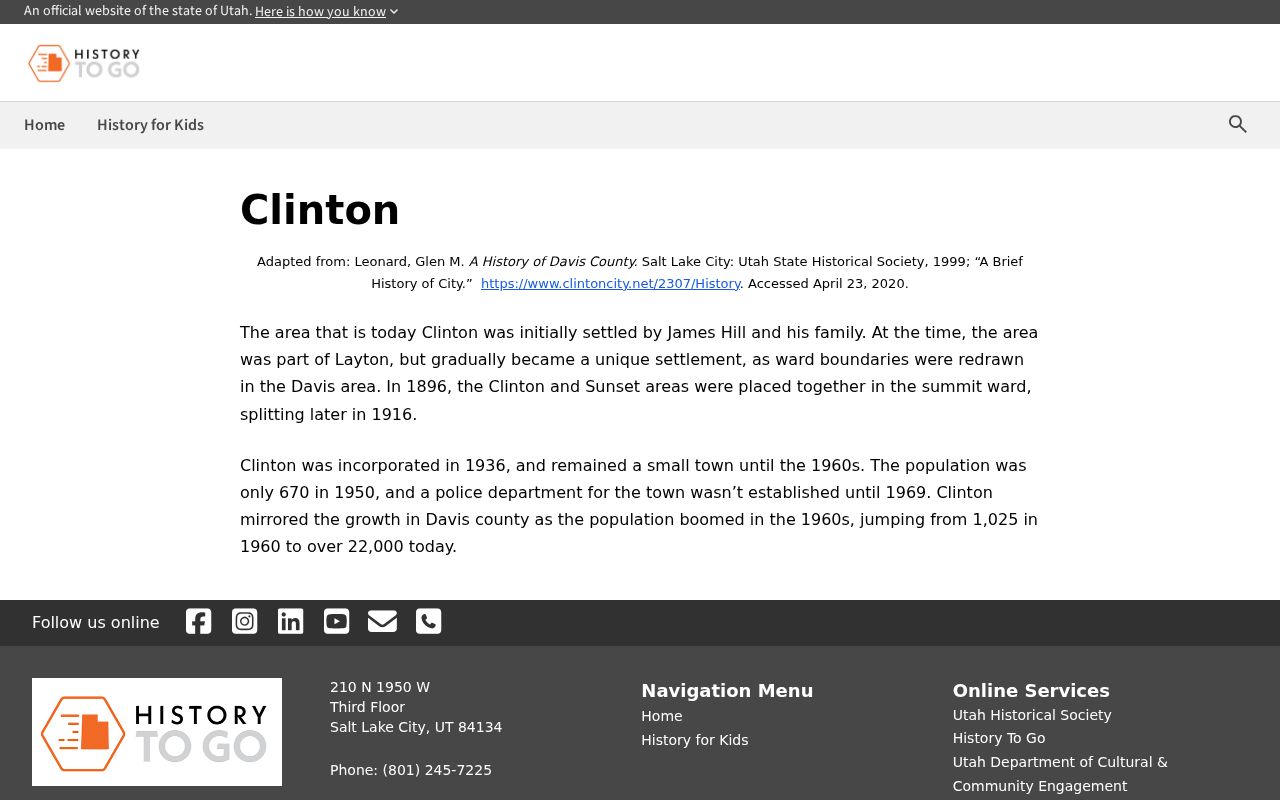
The historical image helps orient a search around Clinton and Sunset, but a history narrative does not replace a directory scan or primary record.
Clinton Records Change Over Time
Directory work makes more sense when the record system’s own changes are visible. Davis County was organized in 1850, Farmington became the county seat in 1853, and the Utah Central Railroad crossed the county in 1870. The Recorder says its historical land-record collection begins in 1870. Clinton’s city history places the first school south of the cemetery in 1885 and the city’s official town status in 1936.
| Period | Local record context | Why it matters to a city directory search |
|---|---|---|
| 1850 to 1870 | County organization, early settlement, paper land records | Search county, ward, church, cemetery, and land labels |
| 1870 onward | Recorder’s claimed historical land-record collection begins | Deeds and plats can bridge an old address clue |
| 1898 to 1905 | County clerks created vital records before statewide certificates | Birth and death research may use local registers |
| 1905 onward | Statewide vital certificates and later archival series | Use Archives and OVRS rules with directory evidence |
| 1981 | County computerization and microfilming modernization | Modern index and image access may differ from paper runs |
The exact Clinton city-directory publisher and year run remains unverified. A history timeline supplies search context, not permission to fill the missing shelf years.
Clinton’s Earlier Community Names
Clinton’s past can appear under more than one label. Official local history names The Range, Sand Ridge, The Basin, and The Summit. Clinton and Sunset shared Summit Ward in 1896, separated in 1916, and Clinton incorporated in 1936. When a surname search fails, add those place names, ward references, and nearby community labels to a newspaper, archive, census, or catalog search.
The physical anchors help too. The first school stood just south of the cemetery in the 1885 account, and the modern Clinton Cemetery is at 813 N 750 W. Cemetery, school, newspaper, and land references can point to the same family, but each remains a separate source. The Library of Congress Utah local-history guide is useful for planning a search even though its online telephone-directory collection does not include Utah.
Reading a Clinton City Directory Entry
No official public holdings page exposed a scan of a Clinton entry, so the safe approach is to use a field checklist rather than pretend a local abbreviation key was captured. The Library of Congress explains that city and telephone directories can carry addresses, occupations, household residents, reverse-address clues, and business affiliations. A local volume may use a different style, and the printed page remains the authority for its own symbols.
| Name | Given name and surname, with initials or a spouse notation when printed |
|---|---|
| Occupation | Work description and sometimes an employer or business affiliation |
| Address | House number and street, with local abbreviations that must be read from the volume |
| Owner or renter mark | A symbol or letter if that particular run uses one; verify its key |
| Status notation | Widow or another status note that can guide family-history research |
| Volume citation | Year, publisher, page, city or neighborhood, and image or reel reference |
- Criss-cross section
- An address-first part of a directory that may lead from a street and number to an occupant or business.
- Householder index
- A name or household list that helps locate a person before the full entry is read.
- Abbreviation key
- The volume’s own explanation of short forms and marks. Find it before interpreting an address or status.
Note: A directory citation is strongest when it preserves the exact page, volume year, publisher, and image or reel reference.
Trace Clinton Families Across Years
Use a Clinton city directory as a time slice, then test the slice with another record. A name can disappear because a family moved, a person died, the volume skipped the household, or the next issue used a different community label. Clinton and Sunset shared Summit Ward in 1896, separated in 1916, and Clinton incorporated in 1936. Earlier searches should allow for rural, ward, or nearby post-office geography.
- Ask the library for the first confirmed directory year and record its publisher, page, city label, and any abbreviation key.
- Follow the name through the next available volumes. Copy the address, spouse notation, initials, occupation, status mark, and page exactly as printed.
- Try the address-first or criss-cross section, if the confirmed volume has one. Treat its run and symbols as unverified until the shelf copy shows them.
- Pair directory observations with federal census years from 1870 through 1950. Census geography and the present Clinton boundary may not match.
- Use an obituary, cemetery record, deed, or probate record to test a family link. Cite the image, page, or series instead of repeating an unsourced conclusion.
Federal schedules released through 1950 are available under the 72-year rule, while later schedules remain closed until their release dates. A directory occupant and a deed owner can be different people. Pair the address with a parcel legal description, a cemetery entry, or a newspaper notice before deciding that a missing line marks a move or death.